
Smoked Mackerel Cassoulet
Smoked mackerel cassoulet isn’t just healthy – it’s tasty, economical and easy to make. If you’re looking for a simple way to up your intake of oily fish, this may be the perfect dish for you.

| Monday | 1:00pm - 6:30pm |
| Tuesday | 8:00am - 1:30pm |
| Wednesday | 1:00pm - 6:30pm |
| Thursday | 8:00am - 1:30pm |
| Friday | 1:00pm - 6:30pm |
| Saturday | CLOSED |
| Sunday | CLOSED |
1 white cabbage, preferably organic
1 dsp flaked sea salt
2 tsp black peppercorns (optional)
½ tsp caraway seeds (optional)
When can you eat it?
We have eaten ours after 4 days but longer is better – try 20 days for a more mature flavour.
Storage.
Unopened it will last for many months, especially if it’s refrigerated. But once you start eating it new bacteria may be introduced so finish it off within 2 weeks.
Signs your sauerkraut hasn’t worked-
If instead of smelling like sauerkraut your cabbage smells off, you should discard it. It should taste sour and should not be pink, grey, black, or mouldy. However, many experienced sauerkraut makers are happy to scrape off a little scum or even mould from the surface knowing the submerged cabbage beneath will be OK. Follow your gut and if in any doubt, throw it away.
Quite a narrow range of foods contain live bacteria, and sauerkraut is perhaps the easiest of them to make at home. Your gut micro-biome will thank you for it, and it only takes a few minutes to prepare. Just make sure that all your equipment is very clean before you start.
How do you grow a healthy gut?
A healthy gut is alive with a wide diversity of good bacteria. These bacteria digest our food for us, and you would not believe how many other benefits they bring to our overall health (Everything from our immune function to our mental health. I’ve written more on the subject here.)
But how do those good bacteria get inside us in the first place? It’s simple. We eat them, and then we feed them the right food to help them thrive. In a healthy gut, good bacteria are crowding out the bad ones. Remember this difference-
Quite a narrow range of foods contain live bacteria, and sauerkraut is perhaps the easiest of them to make at home. (Click here for a list of probiotic food.)
Remember- once you have consumed some good bacteria (in the form of this delicious sauerkraut) you should help them to stay alive and multiply. This is where prebiotic food comes in– you need to remember to eat some. Otherwise it is a little bit like going to the garden centre to buy some lovely golden carp, then sticking them in the pond and forgetting to feed them.
Not sure where to begin?
All dietary fibre is good for you, but only certain types of fibre are pre-biotic. This website explains the difference and provides a list of foods. Many of the recipes on our website contain pre-biotic ingredients. One of my favourites is Smoked Mackerel and Celeriac Salad (it contains fennel and apple.) Another winner is Tahini Lentils with eggs and red onions (contains lentils, garlic and red onion.)
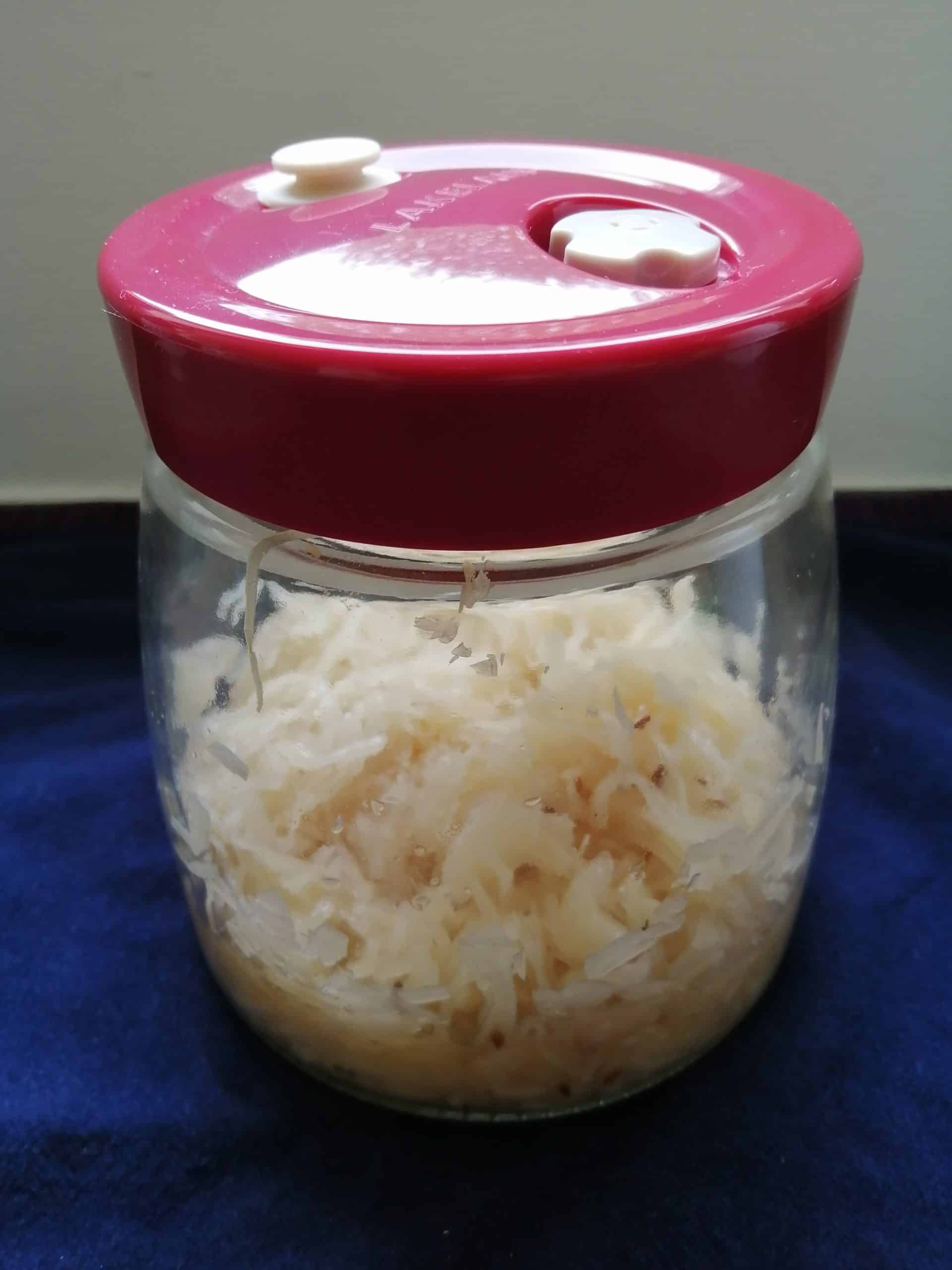
It only takes a few minutes to prepare sauerkraut, but you do need to take care that all your equipment is very clean before you start, especially the storage jar. Squeezing cabbage with your fingers is messy but satisfying.
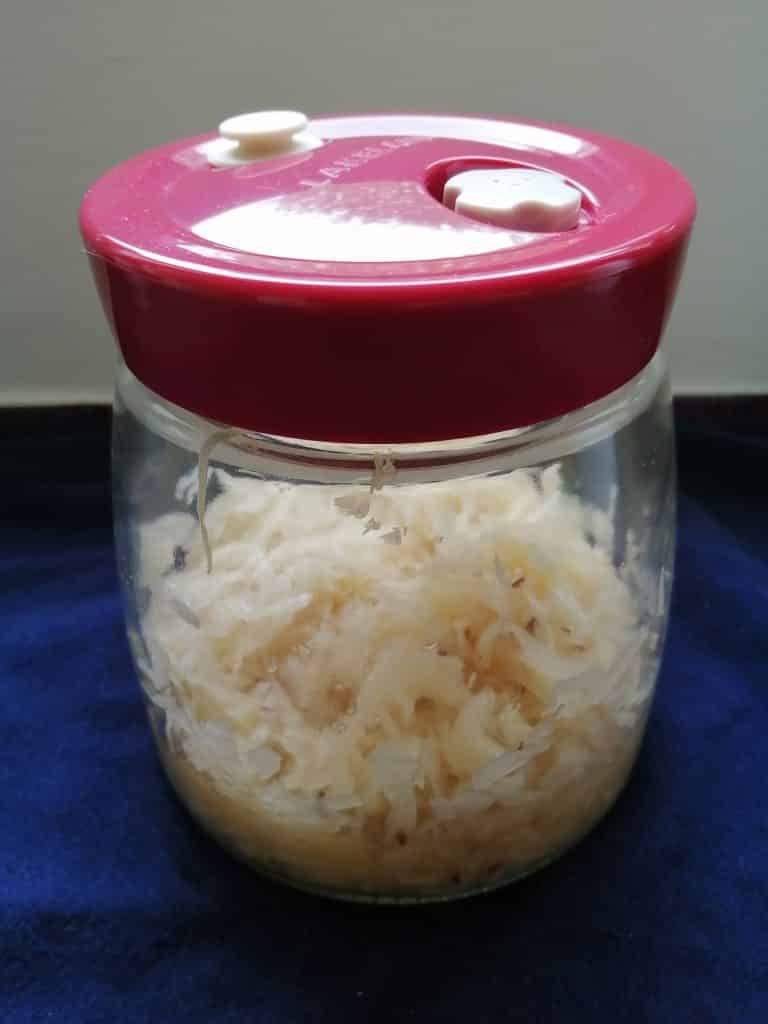
The jar in the photo has a valve which allows the gases released by the fermentation process to escape while not admitting any air. I bought mine from Lakeland but traditionally people made sauerkraut without this. Another way of achieving the same thing is to put a clean cloth over it and secure it with elastic during the fermentation stage (4-7 days) and then replace it with a real lid to preserve it once it’s ready. Alternatively, loosen (and then re-tighten) the lid every few days to allow the gas to escape.
Salt is used to draw out the liquids inside the cabbage – the cabbage should be fully immersed in liquid. You could press it down with a rolling pin and then weigh it down with a clean heavy object. For the batch pictured here I didn’t need to because there was plenty of liquid. Remember that more liquid will be released as fermentation progresses.
My sauerkraut has never failed to ferment – the only issue I’ve had is saltiness. I now use salt with caution, adding a little at a time and seeing how squeezy and wet the cabbage gets. I use as little as I can get away with and seldom use as much as most recipes recommend. You’ll have to use some salt but obviously the less salt you use the healthier your sauerkraut will be.

Smoked mackerel cassoulet isn’t just healthy – it’s tasty, economical and easy to make. If you’re looking for a simple way to up your intake of oily fish, this may be the perfect dish for you.

Lamb broth is a British classic. Every ingredient here is seasonally available in the UK, so if you’re eating this in winter the vegetables will be local and fresh.

This unusual recipe comes from Algeria. It takes very little effort to prepare but it looks impressive and tastes delicious. For a healthy meal full of Middle Eastern flavours, read on.

Of course pancakes are delicious, but I always feel a bit sickened with myself after eating them, and would like to lie down for a nap. Here are two healthier pancake recipes. They are higher in fibre, and contain protein in the form of nuts and seeds, but they still feel indulgent because (after all) they are pancakes.